
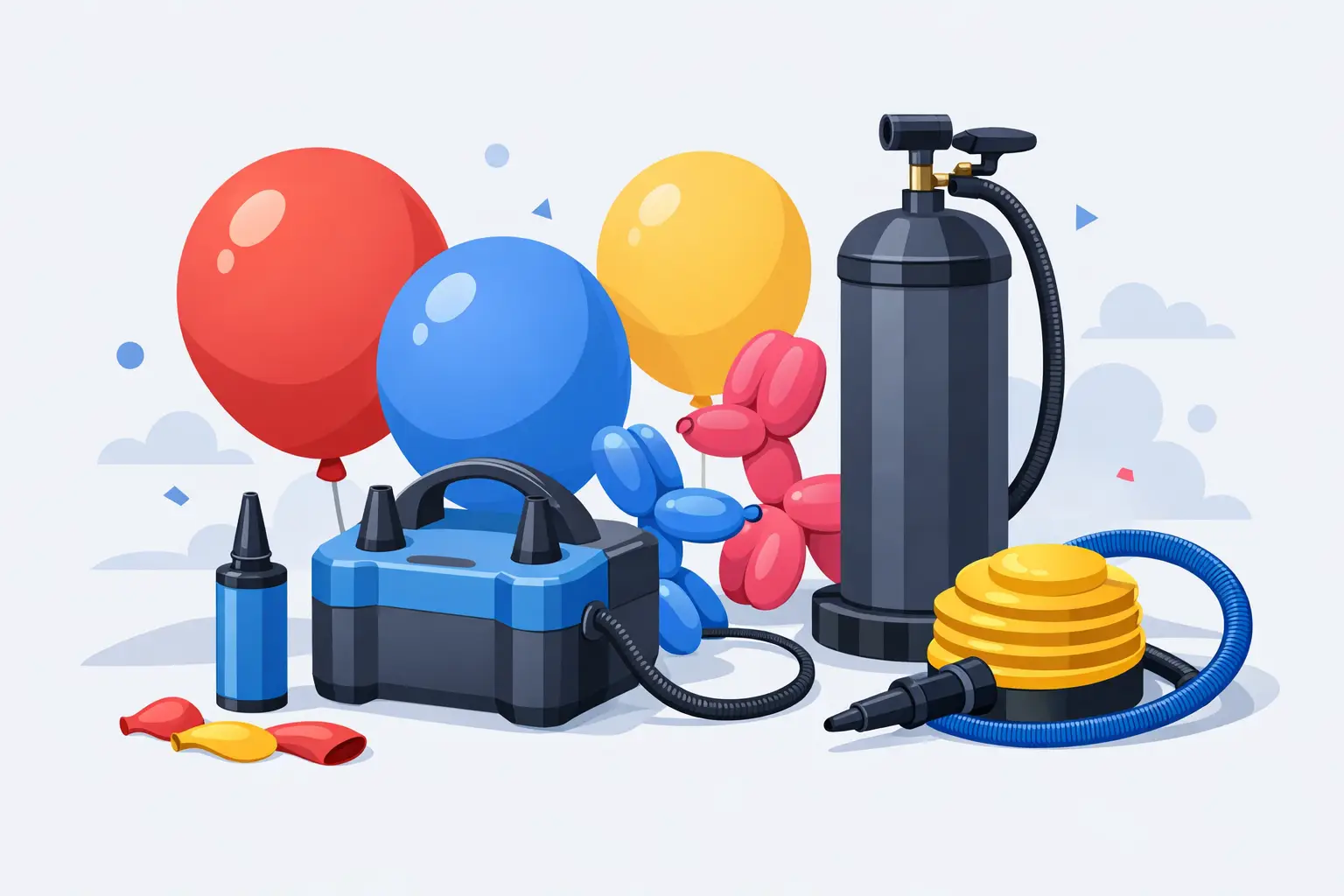
A balloon job can be held up by something as small as an inflator. When you are building a garland before a venue access window closes, inflating stock for a busy retail display, or preparing hundreds of latex balloons for a corporate installation, the question is not simply which balloon pump to buy. It is which pump keeps production moving without compromising finish, balloon condition or your team’s energy.
For trade customers, the right choice depends on balloon type, average job size, working environment and how frequently inflation is part of the day. A hand pump still earns its place in a professional kit. An electric inflator can transform preparation time. The best buying decision comes from matching the equipment to the work rather than choosing on price alone.
Which balloon pump to buy for your workload
Start with the number of balloons you inflate in a typical session, not the biggest job you complete once a year. If you regularly prepare a few dozen latex balloons, a quality manual pump may be the most practical and economical option. If arches, organic garlands, ceiling work and repeat event installations are core to your business, electric inflation quickly becomes a working essential.
Also consider who will use it. A sole decorator working from home may prioritise compact storage and portability. A retail team inflating balloons at a counter needs equipment that is intuitive, quick to clean and reliable across repeated use. An event company may need more than one pump so staff can prepare different balloon sizes simultaneously and keep a spare unit in the van.
The pump should support your operating pace. Saving a few minutes on a small order is useful. Saving an hour on a large installation can protect labour margin, reduce fatigue and give you more time for the finishing details clients notice.
Manual hand pumps: dependable for small jobs and mobile work
A manual hand pump is the most straightforward option for air-filled latex balloons. It does not need mains power, is easy to carry and can be used virtually anywhere, including on-site venues where sockets are limited or inconveniently placed.
Single-action pumps inflate on either the push or pull stroke. They are simple and usually suited to occasional use, smaller orders or emergency kit bags. For professional work, a dual-action hand pump is generally the stronger choice because it moves air on both strokes. That means fewer movements per balloon and a noticeably better pace over a full bag of latex.
Manual inflation gives good control when working with smaller quantities, unusual sizes or modelling balloons. It is also useful for topping up a balloon that needs a little more air once it is tied into a design. However, repetitive use becomes tiring quickly. If your hands, wrists and shoulders are doing the same work every week, the apparent saving on equipment can be lost in preparation time and staff fatigue.
Keep a hand pump even if you own an electric model. It is a sensible backup for power failures, venue work and quick adjustments. For many decorators, it is not a choice of one or the other: the electric inflator handles volume, while the hand pump stays in the toolkit for flexibility.
When a hand pump is the right purchase
Choose a good dual-action hand pump if you mainly inflate small batches, travel frequently, work at venues with uncertain power access, or need a dependable spare. It is also a useful entry point for new balloon businesses building their equipment gradually.
Electric balloon inflators: built for volume
An electric balloon inflator is designed for air-filled latex balloons and is the practical choice when inflation is a regular production task. These machines use a motor to deliver airflow through one or more nozzles, allowing the operator to inflate balloons much faster than by hand.
For garlands and large décor work, the difference is immediate. Inflation becomes a repeatable process rather than the slowest part of preparation. This is particularly valuable with popular sizes such as 5-inch, 11-inch and 18-inch latex, where consistent quantities are needed to create a balanced organic finish.
Look at nozzle arrangement before buying. A twin-nozzle model allows two balloons to be inflated at once, either by one experienced operator or two members of staff. This is useful in a busy prep area, but it only delivers a genuine speed benefit when tying and sorting can keep pace. If one person is inflating and tying alone, a single active nozzle may be more manageable.
Many electric inflators operate when the nozzle is pressed, which gives the user control over airflow and helps prevent overinflation. Some models also offer a continuous-air setting. Continuous airflow can be helpful for large batches, but it requires attention: latex balloons reach their correct size quickly, and overinflation increases the risk of popping during transport or installation.
Noise is another practical consideration. Electric pumps are not silent, and that may matter in a shop environment, shared workspace or residential setting. It is rarely a reason to avoid an electric model for professional volume, but it is worth planning where inflation will happen and when.
Choose capacity over unnecessary features
The most suitable electric pump is not always the one with the longest feature list. Prioritise steady airflow, suitable nozzles, stable construction and a format that fits your workspace. A compact unit is useful for mobile decorators, while a larger model can make sense in a dedicated production area where it will be used daily.
Check that the inflator is intended for the balloons you plan to use. Standard electric pumps are for air inflation, not helium. They are also not automatically suitable for every foil balloon valve, especially mini foils. Using the wrong nozzle or too much pressure can damage the valve or split the balloon.
Do not use an air pump for every balloon
One of the most expensive mistakes in balloon preparation is treating all balloons as though they inflate in the same way. Latex balloons can be air-filled with a hand pump or electric inflator, provided the equipment is used carefully. Foil balloons require more control, particularly smaller shapes and mini balloons.
Standard foil balloons often have self-sealing valves and can be filled with air using an appropriate hand pump and suitable inflation straw or adaptor. Inflate slowly and stop when the balloon is firm but not tight. Foils do not stretch like latex, so an overfilled seam can split without warning.
Mini foil balloons are usually air-filled and need a hand pump, straw or dedicated low-pressure method. They should not be placed directly on a high-output electric inflator unless the equipment and adaptor are specifically designed for that purpose. The airflow can be too forceful for the valve and seams.
Helium is a separate requirement. A balloon pump does not replace a helium cylinder, regulator or approved helium inflator. If a design needs floating latex or foil balloons, plan the gas requirement, float time and inflation method separately. This keeps your purchasing accurate and avoids equipment being used beyond its intended purpose.
Think about consistency, not just speed
Fast inflation only helps if the finished balloons are consistent. Organic décor can accommodate variation, but clusters, columns and structured arches rely on repeatable sizing. A pump provides air; it does not measure the balloon for you.
For professional results, pair your chosen inflator with a sizing method. A balloon sizer, template board or measured guide helps create uniform 5-inch, 11-inch or larger latex balloons. This reduces waste, improves symmetry and makes calculations for frames and garlands more reliable.
Consistent sizing also protects balloon quality. Latex should be inflated to the intended working size rather than forced to its absolute limit. A correctly sized balloon has better resilience during handling, transport and installation. This matters when work is being loaded into a vehicle, exposed to changing temperatures or installed around sharp venue features.
Buying for the way your business works
A retailer may need a compact electric inflator for occasional displays and pre-inflated air-filled ranges, supported by hand pumps at the counter. A florist adding balloon work to gift and event orders may begin with a dual-action pump, then move to electric inflation as installations become more frequent. A dedicated balloon decorator should regard an electric inflator, quality hand pump and correct foil inflation accessories as core working equipment.
Consider continuity too. If balloons are a significant revenue stream, relying on one pump creates an avoidable risk. Keeping a manual backup is low-cost protection when an electric unit is unavailable, a venue has no suitable power point, or an additional pair of hands joins the preparation process.
At Go International, trade buyers can build a practical inflation setup around the balloon types and event work they supply. Choosing reliable equipment alongside professional-quality latex, foil and accessories helps keep preparation consistent from the first order to the busiest seasonal week.
Before your next large job, time how long inflation actually takes and note where the bottleneck appears. That simple check will usually tell you whether a better hand pump is enough, or whether an electric inflator is ready to earn its place on your workbench.