
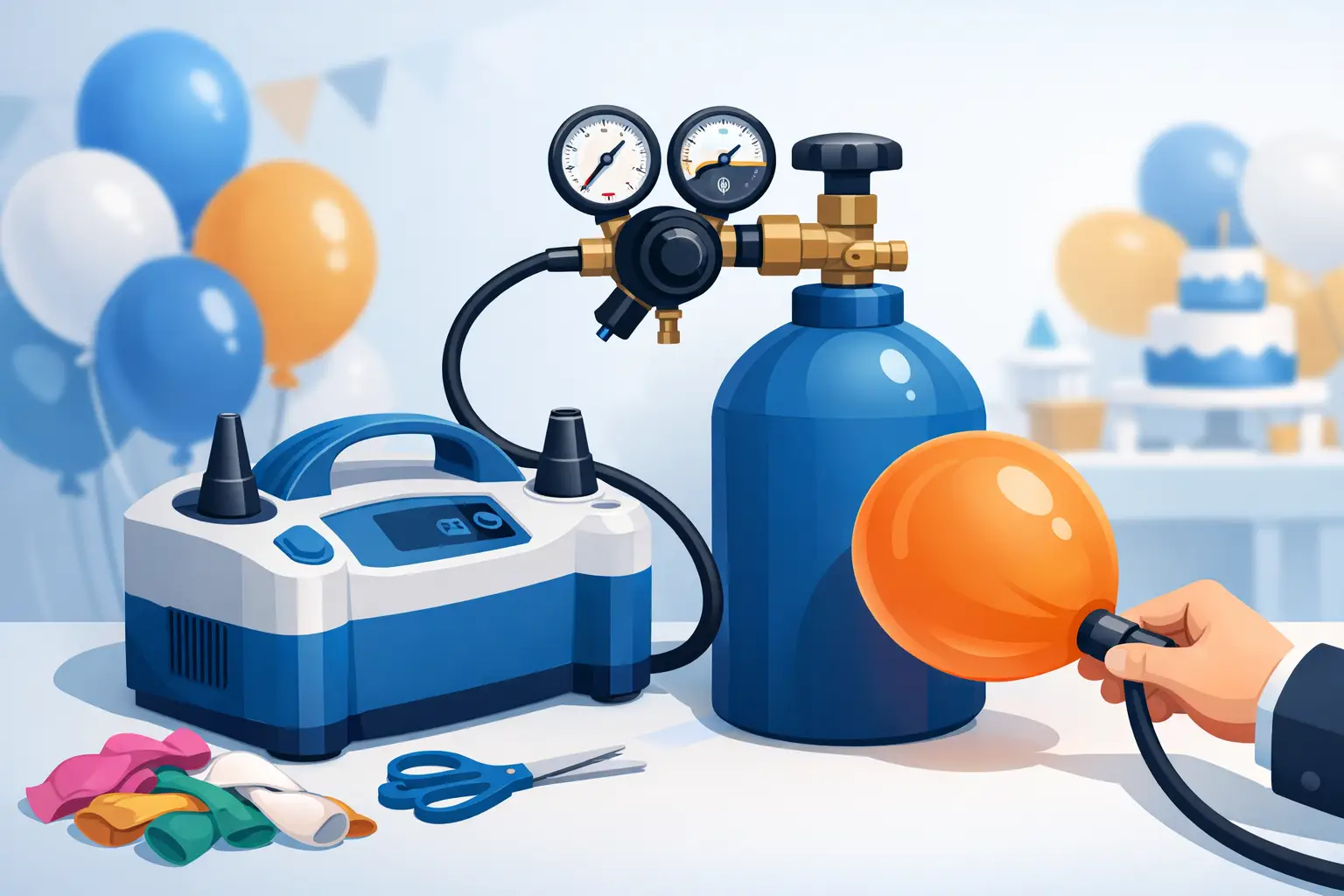
When you are dressing a venue at 7am, with a delivery window closing and a client already asking for photos, a poor-quality balloon inflator becomes a very expensive problem. For decorators, retailers and event teams, the right balloon inflator for professionals is not just a tool – it affects labour time, finish quality, staff confidence and how many jobs you can turn around in a day.
Why a balloon inflator for professionals needs a different standard
Consumer inflators are built for occasional use. Trade use is different. You may be inflating hundreds of latex balloons for an arch, topping up stock for retail display, or switching between standard latex, quicklink styles and smaller foils during a tight setup. In those conditions, speed matters, but control matters just as much.
A professional setup needs consistency across volume, pressure and handling. If one operator is over-inflating and another is under-filling, the finished work looks uneven and the stock loss adds up. That is why the best inflator is usually the one that suits the way you work, not simply the fastest model on the shelf.
For some businesses, that means a compact electric unit that can be carried into venues and packed away quickly. For others, it means a heavier-duty machine that can cope with repeated use across busy seasonal peaks. The right choice depends on output, not marketing claims.
The main types of balloon inflator for professionals
Most trade buyers are choosing between electric air inflators and specialist inflators designed for particular balloon formats. The distinction matters because not every job needs the same setup.
Electric air inflators
Electric inflators are often the backbone of a decorator’s kit. They are fast, easy to use and well suited to large volumes of latex balloons for garlands, columns, clusters and room decor. Dual-nozzle models can be particularly useful when training staff or working in pairs, because they keep the pace up without constantly repositioning the machine.
That said, more power is not automatically better. If airflow is too aggressive, smaller balloons can be harder to control and sizing becomes less consistent. For detailed decor work, accuracy can be worth more than outright speed.
Hand pumps and precision inflators
For mini balloons, delicate work and on-site adjustments, manual pumps still have a place. They are slower, of course, but they give excellent control and do not rely on power at the venue. Many professionals keep one on hand even when using electric kit as their main inflator.
This is especially true when working with smaller foil pieces or air-filled detailing where over-inflation can damage seams or distort the shape.
Foil-specific and low-pressure inflation tools
Foils require a different approach from latex. They do not respond well to high-pressure air blasts, and many need slower, more controlled inflation. A machine that is ideal for standard latex may be the wrong fit for mini foils or shaped designs.
This is where trade experience counts. If your workload includes a lot of personalised foil work, stack bases with foil accents or retail-ready foil stock, make sure your inflator setup reflects that rather than forcing one machine to do everything.
What to look for before you buy
The first question is volume. How many balloons are you inflating on a typical day, and what does peak season look like? A weekend-only decorator handling medium event work has different needs from a retail operation prepping daily displays and seasonal promotions.
Capacity should be judged alongside duty cycle. Some inflators are fine for short bursts, but not for prolonged use. If your team is inflating at pace for extended periods, overheating, slowdown and motor wear become practical concerns rather than technical footnotes.
Control is the next issue. Push-down activation is useful for speed, but foot-pedal or switch-based options may suit certain workflows better. If multiple staff members will use the machine, ease of operation matters. A model that looks efficient on paper can still cause waste if it is awkward to handle under pressure.
Noise is often overlooked until you are working in a confined prep area, a shop floor or a live venue during setup. Some electric inflators are noticeably louder than others. That may not be a deal-breaker, but it is worth considering if the machine will be used regularly around staff, customers or wedding clients.
Portability also deserves attention. Venue work often means stairs, tight loading zones and limited setup space. A solid bench unit may be ideal in a stockroom but frustrating on the road. If your business mixes warehouse prep with mobile installation, size and weight can become deciding factors.
Matching the inflator to the job
A balloon inflator for professionals should fit your most profitable work, not just your occasional jobs. If most of your revenue comes from large organic installs, your priority is likely fast latex inflation with reliable performance over long sessions. If you are heavily focused on gifts, personalisation or mixed balloon stacks, finer control may be more valuable.
This is where some buyers get caught out. They buy for maximum speed, then spend more time correcting balloon sizes, replacing split stock or switching tools for foil work. In practice, that can slow the whole operation down.
It is also worth thinking about staffing. An experienced balloon artist can adapt to almost any machine, but newer team members benefit from straightforward controls and predictable output. If you are scaling the business or bringing in seasonal help, operator-friendly equipment can protect both margins and presentation standards.
Reliability is not just about the machine
For trade buyers, product reliability includes supply reliability. There is little value in choosing an inflator that suits your work if stock is inconsistent, replacement options are unclear or specialist advice is hard to get when you need it.
That is one reason professional buyers tend to work with trade suppliers that understand the category properly. Inflators do not sit in isolation. They are part of a working system that includes latex, foils, valves, accessories, helium planning and event timing. When your supplier understands those connections, buying decisions become quicker and less risky.
Go International, for example, serves professional decorators and retailers who need that kind of practical trade support, not just a box on a shelf. For businesses working to tight event deadlines, that difference matters.
Common buying mistakes
One common mistake is assuming all balloons can be inflated efficiently with one machine. In reality, mixed-format businesses often benefit from using different tools for different tasks. That does not mean overbuying. It means being realistic about workflow.
Another is focusing only on purchase price. A cheaper inflator can look attractive, but if it slows teams down, creates more wastage or fails during busy periods, the real cost is much higher. Trade buying should always account for labour and reliability, not just unit price.
The third mistake is underestimating maintenance and handling. Even a good inflator will have a shorter working life if it is dragged between venues without protection, used beyond its intended duty cycle or stored carelessly after jobs. Professional use demands professional habits.
A practical approach to choosing well
Start with your balloon mix. Be honest about how much of your work is standard latex, larger decor, mini balloons or foil. Then think about where inflation happens – in-store, in a workshop, on-site, or across all three.
After that, consider who uses the equipment. If it is only you, you can choose around your own pace and preferences. If it is a team tool, prioritise consistency and ease of use. The best trade equipment reduces variation between operators.
Finally, buy with busy periods in mind. An inflator that copes well in February may struggle in December, graduation season or wedding peaks. If your calendar has obvious demand spikes, choose equipment that can handle your hardest month, not your easiest one.
A good balloon inflator will never be the most glamorous item in your stock room, but it can be one of the most commercially important. When the machine fits the job, setups run faster, teams waste less product and clients see cleaner results. That is usually the difference between getting through the day and staying ahead of it.