
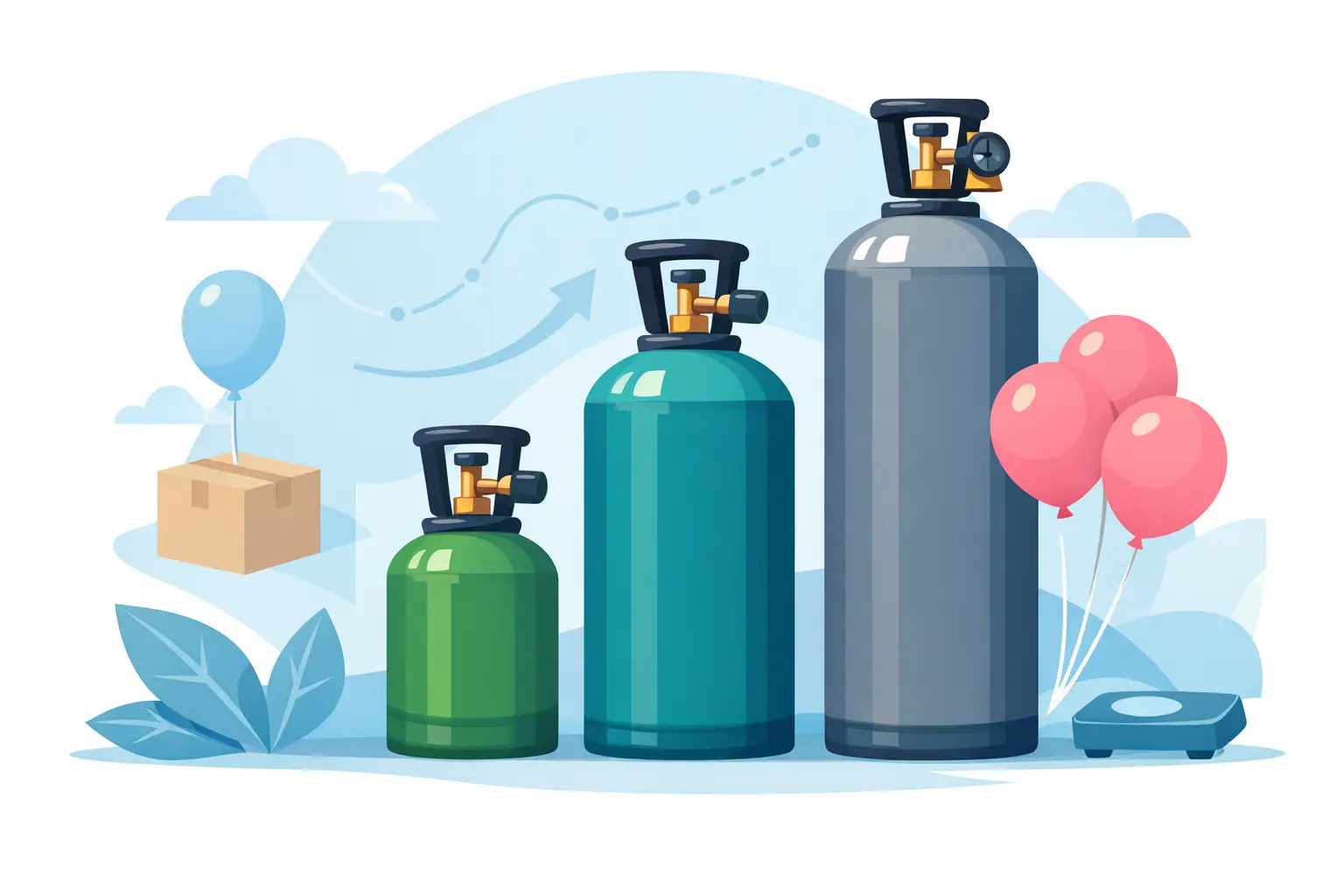
Order too small a cylinder and the job slows down halfway through prep. Order too large and you tie up cash, storage space and handling time in gas you did not need. If you are working out what size helium cylinder is right for your business, the answer comes down to balloon mix, event volume, turnaround speed and how much margin you need to protect.
For trade customers, helium is not a casual add-on. It affects labour planning, delivery schedules, on-site efficiency and profitability. A florist inflating a handful of get well foils needs a different setup from a balloon decorator building multiple ceiling installs over a weekend. The right cylinder size is the one that fits your workload without creating waste or operational drag.
What size helium cylinder depends on
The first mistake is choosing by cylinder height or weight alone. In practice, the useful measure is gas capacity and how many balloons that cylinder will inflate at the size you actually sell. A cylinder that looks substantial may still be a poor fit if most of your work involves larger latex, bubble balloons or oversized foil shapes.
Balloon type changes everything. Standard latex and foil balloons do not consume helium at the same rate, and once you move into larger diameters, double-stuffed designs or statement pieces, gas usage climbs quickly. Inflation style matters too. A tightly inflated balloon gives the finish clients expect, but overinflation wastes gas and can shorten float performance or increase burst risk.
Your event pattern is just as important as your balloon spec. Some businesses run steady daily trade in small quantities. Others have sharp weekly peaks, seasonal surges and one-off large jobs. If your demand is predictable, you can size cylinders closely. If it swings, a little spare capacity is often cheaper than an emergency reorder or a failed installation window.
Start with the balloons, not the cylinder
A practical way to answer what size helium cylinder you need is to estimate your job in balloons first, then work backwards. Count the exact mix you expect to inflate – for example 11 inch latex for bunches, 18 inch foils for retail sale, or larger decor pieces for a venue install.
This matters because two jobs with the same balloon count can require very different gas volumes. Fifty small foil balloons for shop sales are not the same as fifty 16 inch latex balloons for a corporate setup. If you regularly switch between balloon formats, relying on a rough average usually leads to under-ordering.
For decorators, it also helps to separate client-facing quantities from actual inflation quantities. A design may be sold as one installation, but your gas requirement sits inside the detail – how many helium points, what sizes, and how much contingency stock is travelling to site. Professionals already know that the quote and the fill plan are not always the same document.
Small jobs and daily retail work
If you are inflating limited numbers of foil balloons, birthday bunches or occasional latex orders, a smaller cylinder is usually the better commercial choice. It keeps storage simpler, reduces unnecessary spend and suits businesses that sell helium as part of a wider product offer rather than as a high-volume speciality.
This is often the right fit for party shops, florists and retailers with regular but modest turnover. The key advantage is flexibility. You can cover day-to-day demand without committing to a larger gas volume that may sit idle between busier periods.
Medium-volume trade demand
For businesses handling a regular flow of orders, medium cylinder sizes tend to offer the best balance. They support better unit economics than very small cylinders but remain manageable for typical trade operations where space, access and stock rotation still matter.
This is where many professional decorators and busier retailers sit. You have enough throughput to benefit from greater capacity, but not every week justifies your largest possible cylinder. If you are inflating for weekend events, school proms, weddings and corporate work on a rolling basis, medium capacity often matches the pace of the business.
Large events and high-output decorators
Larger cylinders make sense when helium usage is consistent and substantial. If your team is producing multiple installs, large ceiling jobs, venue dressing or high-volume latex work, bigger capacity reduces stoppages and avoids the inefficiency of switching cylinders mid-prep.
There is a trade-off. Larger cylinders require appropriate storage, handling discipline and clearer planning around transport and access. But where output is high, those operational demands are usually outweighed by fewer interruptions and better cost control per balloon inflated.
What changes the answer in real jobs
Helium planning looks straightforward on paper until real-world variables appear. Travelling time, weather, venue access and installation sequence all affect how much margin for error you need.
If you inflate on-site, cylinder size is partly a logistics decision. A more compact option may be easier to move through service corridors, lifts or tight loading points, even if a larger cylinder offers better raw capacity. If you pre-inflate off-site, storage time and float planning become more important than portability.
Seasonality also changes the calculation. Around Christmas, Valentine’s, Mother’s Day and graduation periods, many trade buyers shift from their normal pattern. Retail foil sales can jump sharply, and decorators may have less room to recover from supply delays. In these periods, sizing slightly above your base demand can be the safer commercial decision.
Another common issue is mixed workstreams. If your business serves walk-in retail, pre-orders and event decor from the same stock position, helium usage becomes harder to forecast. In that case, one cylinder sized only for a major event may leave you short for profitable day-to-day sales, or vice versa. Separating expected retail demand from booked event demand usually produces a more accurate answer.
Use capacity charts properly
Helium charts are useful, but only if you treat them as planning tools rather than guarantees. They are based on standard inflation assumptions, and actual output can vary depending on fill level, nozzle use, balloon quality and operator consistency.
For trade buyers, the sensible approach is to use chart figures as a working baseline, then build in tolerance. If the event matters, do not buy to the exact last balloon. Allow room for testing, replacements and minor variances between brands and sizes. That small buffer is often the difference between a controlled prep day and a last-minute scramble.
This is especially true with larger latex balloons, custom work and installations where visual consistency matters. A slight shortfall in helium is rarely just a gas issue. It can become a staffing issue, a delivery issue and, ultimately, a client confidence issue.
Cost, margin and waste
The cheapest cylinder is not always the most profitable, and the biggest is not always the smartest. What matters is the relationship between cylinder cost, output and the type of jobs you sell.
If you are paying for capacity you do not use, margin is being lost quietly in the background. If you repeatedly buy too little and top up reactively, you often pay for that in admin, rushed logistics and lower productivity. Good cylinder sizing sits in the middle. It aligns with your average demand while leaving enough headroom for commercially realistic fluctuations.
For some businesses, that means keeping one core cylinder size as standard and adjusting only for peak periods or larger confirmed bookings. That approach is often easier to manage than constantly changing format based on guesswork. It also gives staff a more consistent basis for quoting, prep planning and stock control.
So, what size helium cylinder should you choose?
If your helium sales are occasional and low volume, stay with a smaller cylinder that keeps spend proportionate to turnover. If helium is part of your weekly trade rhythm, a medium cylinder often gives the best balance of capacity, handling and cost. If you are producing larger installs or frequent volume work, a larger cylinder is usually the practical choice because downtime costs more than surplus capacity.
The better question is not simply what size helium cylinder to order, but what size supports your operating model. Think about your typical balloon mix, your busiest week rather than your quietest one, whether inflation happens on-site or in-house, and how much contingency your jobs genuinely need.
Trade buyers do best when helium is treated as part of the production plan, not a last-minute consumable. If you size it with the same care you apply to stock ordering, staffing and event scheduling, it becomes far easier to keep jobs moving, protect margin and deliver a more reliable service.
If you are still between two sizes, choose the one that matches the work you are most likely to repeat – not the one that only fits the best-case forecast.