
Helium Balloon Safety – I was working from home today. This Morning was on in the background, the way most of us have the telly on while trying to get through the day’s work.
Then a headline appeared and everything else stopped.
“Our son died after inhaling a helium balloon.”
An eight-year-old boy had been found in his bedroom. Across the television screen sat two parents, devastated beyond words, trying to warn others while carrying unimaginable grief.
Naturally, they want helium balloons banned.
No reasonable person could hear their story and fail to understand why.
A paediatrician calmly explained the science to viewers. Meanwhile, the retailer involved declined to comment. Sitting at home, I found myself thinking the same thing repeatedly:
This conversation should have happened before the balloon left the shop.
Why Helium Balloon Safety Matters More Than Ever
After forty years in this industry — including seven years serving as Chairman of NABAS — I have discussed helium balloon safety more times than I can count.
Trade shows, supplier meetings, retailer visits and conference panels have all included this exact conversation.
Yet somehow, we are here again.
A family is grieving an unimaginable loss.
Meanwhile, the retailer involved has remained silent.
Once again, a medical professional is left explaining a danger our industry should already have addressed.
Every single one of us must do better.
What Is Helium — And Why Is It Dangerous?
Years of squeaky-voice party tricks have badly damaged public understanding of helium.
Many sensible, responsible adults still see it as harmless fun.
From a scientific perspective, helium is a noble gas. Being colourless, odourless and inert makes it useful for inflating balloons because it is lighter than air.
That same scientific explanation often leads people to assume inhalation is harmless.
Unfortunately, that assumption is where the real danger begins.
What Happens When Someone Inhales Helium?
Breathing in pure helium quickly replaces oxygen inside the lungs.
Without oxygen, the brain and body cannot function.
Most people assume the body would immediately warn them.
Surprisingly, that is not how human biology works.
Your body’s panic response is triggered by rising carbon dioxide (CO2) levels rather than falling oxygen.
Because helium remains chemically inert, carbon dioxide continues leaving the body as normal. As a result, CO2 does not build up and the emergency warning system never activates.
Someone inhaling helium may experience:
- No choking sensation
- No gasping for air
- No feeling that anything is wrong
Instead, unconsciousness can happen within five to ten seconds.
In some cases, irreversible brain injury may begin within a minute if normal breathing is not restored.
Far from being harmless, helium can become deadly before somebody even realises danger exists.
Real Cases Show This Is Not Hypothetical
Sadly, this is not theoretical.
Reports have included a five-year-old child playing with a dinosaur-shaped balloon at home. News coverage has also included a teenage girl dying on the morning of her birthday. More recently, an eight-year-old reportedly lost his life after a birthday balloon had been floating in his bedroom.
Only a handful of these tragedies ever make national headlines.
Many more go unnoticed.
Coroners have issued warnings. Public health discussions have followed. Despite this, dangerous misunderstandings continue.
The Dangerous Myth: “It Only Happens to Someone Else”
Throughout my career, I have seen responsible adults inhale helium simply to make children laugh.
At parties, sensible people have casually breathed from a nozzle for entertainment.
Television presenters and celebrities have even demonstrated it on air.
Whenever concerns are raised, the response often sounds familiar:
“That only happens to someone else.”
Reality tells a different story.
Ordinary families are affected.
Responsible parents experience tragedies like this too.
The heartbreaking truth is that nobody expects it to happen to them.
Should Helium Balloons Be Banned?
For a moment, I may say something unpopular.
No, I do not believe a ban is the answer.
Completely understandably, grieving parents may feel differently and I would never criticise that position.
Removing helium balloons entirely would not remove the danger.
Instead, sales would likely move underground.
Cheap imports already flood online marketplaces. Untrained sellers operate without insurance. Safety guidance disappears when accountability disappears.
History shows repeatedly that pushing industries into the shadows rarely removes risk.
Education Is the Real Answer
Education remains the only realistic solution.
Responsibility sits with us — the people selling balloons.
Approved helium balloon products already contain warnings on their packaging, and GO International has worked alongside manufacturers and trading standards to improve standards.
Unfortunately, customers rarely see those warnings.
After inflation, the balloon goes onto a ribbon.
Customers leave with the finished product.
Behind the counter, packaging containing every printed warning often ends up in the bin.
A Simple Helium Balloon Safety Solution Every Retailer Can Implement
No act of Parliament is needed.
No expensive investment is required.
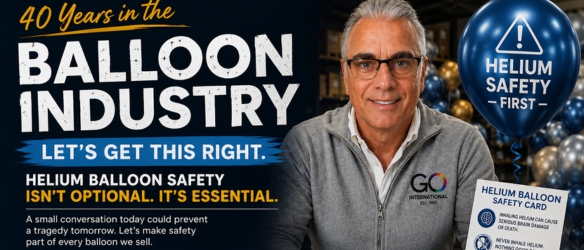
Something as simple as a printed safety card could make a real difference.
A short leaflet handed over with every helium balloon sale can include:
- A clear warning never to inhale helium
- Advice on supervising children
- Instructions for safe disposal
- Guidance on removing balloons after celebrations
Attach it to the ribbon.
Pop it into the customer’s bag.
Leave a stack beside the till.
Whatever works best for your business, simply make sure customers receive it.
Download Our Helium Balloon Safety Card
A downloadable helium balloon safety card has been created for balloon professionals to adapt and use.
Feel free to add your branding.
Alternatively, use it exactly as provided.
Most importantly, start using something.
A Message to Balloon Decorators and Party Professionals
Home-based decorators, weekend side hustles, part-time sellers and established retailers all need to hear this.
The moment money changes hands for a helium balloon, professional responsibility begins.
In difficult circumstances, products we sell can become dangerous.
Nobody joins this industry expecting responsibility to feel this heavy.
Ignoring reality, however, changes nothing.
Forty years into this profession, and after seven years as Chairman of NABAS, the same heartbreaking conversations are still happening.
Grieving parents continue educating the public about dangers our industry should already have explained.
Please, have the awkward conversation.
Print the card.
Tell customers never to inhale helium.
Encourage parents to remove balloons once celebrations finish.
Suggest safe deflation and disposal.
Most importantly, remind people that tragedies always seem impossible — until they happen.
Final Thoughts: We Owe Families Better
Every child whose name should never appear in a coroner’s report deserves better from us.
Parents carrying unimaginable grief deserve stronger education and clearer warnings.
Customers deserve better conversations at the point of sale.
Helium balloons should bring joy.
Without education, however, joy can quickly turn into tragedy.
Print the card. Have the conversation. Help keep children safe.
About the Author
George — GO International & The Balloon Academy
Wishing you health, happiness and success in all you do.
FAQ: Helium Balloon Safety
Can inhaling helium from a balloon be dangerous?
Yes. Inhaling helium replaces oxygen in the lungs, which can quickly lead to unconsciousness, brain injury or death.
Are helium balloons safe for children?
Helium balloons can be safe when used responsibly and under adult supervision. Children should never inhale helium or be left unsupervised with foil balloons.
Why does helium make your voice sound funny?
Helium changes how sound waves travel through your vocal tract, creating a higher-pitched voice. While often treated as entertainment, inhaling helium can be extremely dangerous.
Should helium balloons be banned?
Many industry professionals believe education and better safety practices are more effective than bans, which may drive unsafe sales underground.